Tuesday, September 20, 2011

Managed Chaos

The pharmacy students always choose the back of the bus!
Our first full day of work-- no anxiety today after seeing about 40 patients yesterday. We felt prepared. Our schedule is set for the rest of the week: breakfast at 7:30, leave in the Camp Hope van for the church north of Quito at 8:30; start seeing patients at 9. I did point out to the team today that we are being driven driven back and forth in the short bus, as they wondered why people stared at us all along the route. Our journey begins on our narrow street, and we quickly merge into a wide, crowded boulevard lined with luxury shops selling the latest Paris fashions-- the dresses in the window were all red today instead of yesterday's blue. At most intersections, indigenous woman in bowler hats and blankets sell vivid oranges in long narrow nets-- maybe 10 oranges to each bag. These woman look very tired and defeated by life. I wonder how many orange ribbons they sell every day-- enough to eat? I wish I could take a picture of them but it seems almost exploitative to do so.

 As we drive north through Quito on the Pan American highway, the crowded city street begin to open up to expansive views of the highlands that line Quito on both sides. At first, the hillsides are all houses, every tree stripped away and every inch of earth covered in cement houses--a never ending maze. I wonder how wide the streets are on these hillsides, as it doesn't appear that there is any space at all between the buildings. As the cement fields finally end, the terraced fields take over the hillsides with dense forests above and below. In the morning the sky is bright blue and the clouds high and white. Sunshine reflects warmth and the air feels perfect. On the way back, the clouds have darkened to a dull grey and settled down onto the mountain tops and wisps tease the valleys. There is usually an intense but brief rain-- on Sunday we were treated to a violent thunderstorm. And then it ends. The clouds stay low and the air cooler, but the blue rejoins the sky.


Dr. Shariat and Thanh Nguyen interview a patient

Dr. Wilcox exams a patient while his mom looks on
 Thirty or so patients are sitting in a small room upon our arrival. Some smile and wave and greet us with holas. Others clearly aren't sure what to do as we wind among the chairs carrying duffels and boxes, returning greeting. Two little boys in the front row are anxious to show off their English and say "hello, how are you?". I reply in my finest English. We have no nurse today to assign a # to patients and take vitals. A volunteer is trying but she has no stethoscope, so I run up to dig out the extra.


The delay is welcome as it gives the pharmacy students and residents time to set up and get organized. I am summoned back down stairs-- the volunteer is unable to get a small boy's blood pressure-- the cuff is for adults and won't work for children. I inquire as to who this boy belongs to. I'm told he is "special" and he is here alone. He is a little limp and doesn't tell us his name. Now imagine if you will-- a small room with about 30 people sitting very politely and quietly in chairs with more arriving by the minute, a volunteer who isn't really sure how to check people in, pharmacists rapidly sorting and shelving meds, doctors waiting to see patients, of which none are ready, church volunteers speaking rapid Spanish to an English-only speaker (me) while I am simultaneously trying to get at least three patents ready to be seen, running up and down the stairs delivering requested supplies and trying to figure out how much to worry about this mute little boy. I take him by the hand and lead him up the stairs-- he has a hard time. I find a translator who tells me his name is George. We start calling him George. A few minutes later, he finally speaks and tells us his name is actually Edison. Progress. The rest of the story was pieced together from multiple sources. He was at the church for breakfast and had a seizure ("crisis"-- took me a bit to figure that out). He was post ictal when I first met him-- not "special". I asked one of the residents, Carrie Wilcox, to take him as her first patient.

When I next checked in with Edison, his mother was there with a baby in a blanket papoose on her back and an older sister at her side. Her face was full of concern and worry. Edison has had seizures since he was hit in the head at age 4-- he is now 10. Dr. Wilcox was working with the social worker and the mother-- Edison does take seizure meds but he has been having more and more. We decide it's worth getting a blood level-- figuring out how to write an order for one blood test took 30 minutes and three translators. The mother leaves.

By this time there are probably 50 people upstairs in a relatively small space, kids are running everywhere, the vitals are becoming rare, no one is selected by their #, but rather by who knows the church volunteers, and we have made almost no headway. It really was (mostly) managed chaos. Just as we started to make headway, we were told that it was time to stop and eat. It was only 11am, so as we were shooed out of our rooms we stared bewildered-- lunch isn't until 1 pm. I'm told the pastor wants us to stop and take a break and we find the table set with Doritos and watermelon. My American culture brain cries out "are you crazy? We have patients literally holding up walls for lack of space, we can't stop now!!" but we all sit gratefully and eat Doritos and watermelon and savor the pastor's favorite juice. It was very very nice. We just aren't used to taking breaks. I check in with the doctors on how many patients have been seen and suggest that we may need to speed up. Edison shows up with his mother before we get back to work. He's just had another seizure. We did what we probably should have done initially and just increase his dose-- it's really hard to give up data when that is the world we work in. Data costs money and many of the people we saw today barely make it day to day. They have no budget for data.

Calvin Culver teaches a patient how to check her blood sugar, with Martin translating

Dr. Weiland dispenses medicine from the mobile pharmacy

Amanda Steele, pharmacy student


Mimi Choate saw a woman whose blood pressure was sky high because she was out of meds--we have some emergency meds with us, but they didn't work at all. She went to the ED, because it was the only way she could get new prescriptions. Bridget Shariat, the other resident, started her day with the two boys who had greeted me in English-- their parents were worried about their foreskins and the boys (prepubertal) were worried about their penis sizes being too small--supposedly from eating too much ketchup. We solemnly (on the outside only, inside I was laughing) examined them and declared their penis' perfectly sized. I think this must be a concern that transcends culture. Dr. Shariat ended her day with a young girl who lost both eyes to cancer as a baby. She wears prosthetic eyes, which now fit poorly and were infected. I can assure you I have no experience with the care of nor the treatment of prosthetic eyes. Dr. Christy Wieland, my pharmacy counterpart, helped tremendously and we picked an antibiotic, used some of those last minute donations from the Eye center, and did the best we could. We saw 76 people today- 76 stories. Some very sad, many perplexing and we could only guess what the best course was, some happy, as whenDr. Wilcox let the 45 year old woman with 8 children know that her pregnancy test was negative after two missed periods. Everyone is so nice and grateful and wonderful to work with. Tonight we head to old town for a little touristing. Buenos nochas. No time to edit! 

Monday, September 19, 2011

First Impressions

First impressions. No matter how much we read ahead of time, how many pictures we viewed or how many people we talked to, today was very different than any of us had expected. Our duffel bags loaded to set up our mobile clinic, we first headed to Camp Hope for a tour before seeing patients at a near by church. It was much smaller than we had anticipated from the pictures-- hidden behind white washed cement and cinder block walls with a view of the surrounding mountains, this tiny little enclave in the middle of a city of 1 million people treats, teaches and loves the poorest and most severely disabled children. The narrow halls were stacked with boxes and supplies, five large pots bubbled with delicious smelling food attended to by a single cook in a spotless kitchen, tiny classrooms had kid sized sinks for children to learn to do dishes and practice brushing teeth, another room lined with mattresses on the floor for occupational therapy, a small weedy playground with children sitting in a neat row in their wheelchairs, surrounded by caretakers-- two from Germany here for a year long internship. A neat, blue painted infirmary had a nice stock of medications and a nurse. A friendly dog begged for attention from his small pen. We saw the new tile floor they were able to lay over cement with the team donation money. The buildings and rooms used to be a house-- they lifted up a trapdoor in a plywood floor in one room to show us the swimming pool underneath, now used for storage. Some children grinned and either waved us to them or waved us away; many children were too disabled to notice. I don't think any of them are able to speak words, but their eyes speak volumes.
Camp Hope Courtyard
We will see each one for a wellness exam next week. Back in our van, we drove to Camp Hogar, the orphanage. We all thought it was at the school, but it was a short drive away down a very steep hill. The children were all at the school, so the home was empty. Unlike the crowded, cinder block and cement school, the orphanage was spacious, sunny, tiled, new and beautiful. We were speechless. Four bedrooms with 5 neatly made up beds each, cheerful murals painted on the walls, wide hallways for wheelchairs, sun streaming in every window with expansive vistas was not quite what we had expected. The home was built five years ago by the church in Texas that sponsors Camp Hope. It was almost too nice to be believable. Each child taken into the home is severely disabled and abandoned, and here they have comfort, nutrition, warmth, love and care. It may not be a loving mother and father, but it's close. And yes, yet another dog begged for attention in a pen in the overgrown yard complete with a swing fitted for wheelchairs.
Camp Hogar playground
 Back in the van, already late for the patients expecting us at 11 am, we headed back up the steep hill. We went back down the steep hill-- backwards and in first gear. Eduardo, our driver, tried a second and then a third time. This van wasn't making it up that hill full of these American volunteers who weigh a whole lot more than tiny little special children. We got out and walked up the hill to the Pan American Hwy, located a rickety green metal stairway that crosses the six lane highway and went up and over, staircase wobbling over the cars and trucks zooming underneath. We must have looked like a strange group of hitchhikers on the other side.

 I can't describe the outside of the church--most building here hide behind the ubiquitous cinder block walls topped with razor wire, broken bottles or tall fences. Inside, however, was a modern, tiled church with a spiral staircase leading to the second floor. On the way up we glimpsed about 40-50 people sitting politely and very quietly in the chapel, best clothes on, a few in traditional Andean hats and blankets, and a few in the white apron and hats from the nearby market. The pastor was an extraordinary man between 50 and 60, dressed neatly casual, who spoke excellent English and was most concerned that we had all we needed. We, meanwhile, were astounded-- we had been told by previous volunteers to expect the basest of conditions, no exam tables, no privacy, and no sanitation. We gaped at the green tarps that had been neatly hung around the room, creating five private spaces, each with a tiny table, chairs, and an exam table, and a step stool whose practicality became obvious very quickly--indigenous people are very short. The church members had created a space--with shelves-- for our pharmacy. We wasted no time unloading our duffels, getting patients into rooms based on the handwritten number they were given, and getting to work.

Dr.'s Carrie Wilcox, Mimi Choate and Bridget Shariat

Mari with Dr. Christy Weiland and Christine Keldson
 We saw a huge variety of diagnoses today-- strep throat, hungry kids, stomach flu, chronic pain, anxiety, stomach ulcers, a tongue mass that looks suspicious for cancer, back and neck pain in the women who work the market and are on their feet all day, people with envelopes of test results who needed to know what they meant, teenage acne, people with stories they needed to tell, and people who came for "vitaminas" and anything else we might have to make their bones strong. We tried to give everyone a little something-- they had spent their day waiting for the American doctors. The kids loved the little gliders we handed out--Fernando, 8 and the son of one of the church workers, made sure we each had a turn flying the glider to him. The four hungry children, who are the youngest four of nine, each clutched their gliders and smiled for our cameras-- but what they really needed was food. The church will help. The woman with the tongue mass was encouraged to go to a nearby oncology clinic, because if they biopsy the lesion and it's cancer, they are obliged to treat her. We all learned a little more about ourselves as we learned about them. First impressions--smaller, bigger, heavier, incredibly organized, seeing the needy and the not needy, seeing chronic needs and acute needs, collecting stories, and receiving unmeasurable kindness from our hosts. It was a great first day.  www.camphopeecuador.org

Sunday, September 18, 2011

Almost overwhelming

Mari with her foster son, Ronald
Almost overwhelming. Operative word, almost. A big grin made it all worth it. But I'm ahead of myself. Meet Mari. If you believe in angels on earth, you can believe in Mari. A Quito native, she started volunteering at Camp Hope at the very beginning. At age 16, her church asked for volunteers to help in a week long vacation bible school type summer camp set up by American missionaries. By age 19, she and two other teen volunteers were organizing a full day care for special children. Nineteen years old! She has devoted her entire life to these children, received her degree in education-- and now she is in medical school, while taking care of Ronald, a severaly disabled child she practically kidnapped from the orphanage. She was providing respite care to Ronald, but when they asked for Ronald back, she refused. Sounds like quite a battle that she won (no surprise there!). We met him (now 10) at dinner tonight. She is a dynamo--a slight woman who never stops moving, talks with her whole body and laughs easily and often. I feel like like I've known her forever and I want to know her forever. She is our guide here. She spent her day orienting the team to our work and to local culture--example--Ecuadorians are friendly, talk loudly, interrupt freely, love to hug and if the cheek kiss doesn't have a loud enough smacking sound, the person will think you are mad at them. Good to know-- I'm perfecting the cheek kiss smack now. She led us in team building games, set team and personal goals, and toured us around the neighborhood. (Fortunately, the mountains are to the West, just like home, so we can't get too lost).

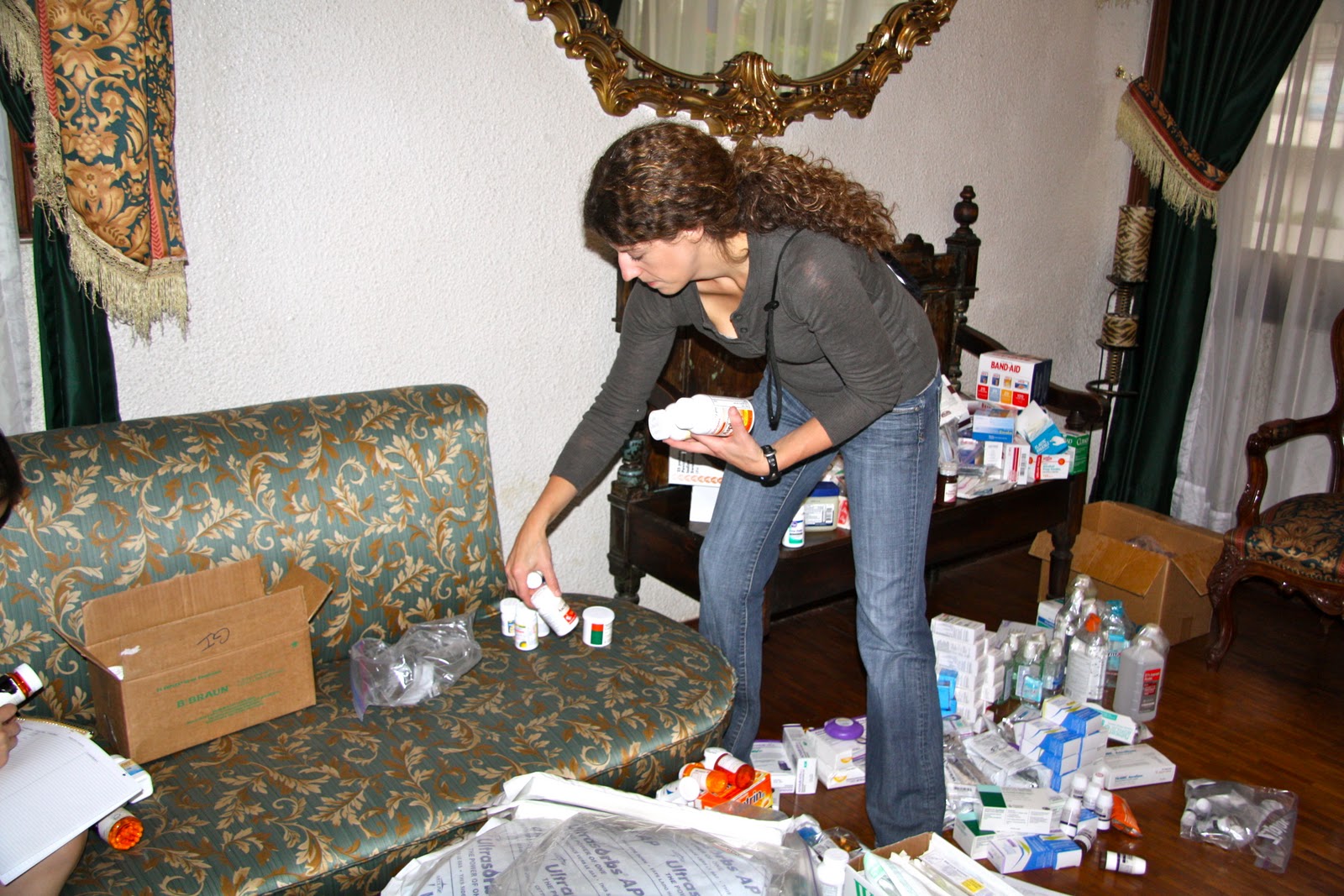
 The limited down time from orientation after lunch was spent unpacking and repacking and unpacking and counting and sorting, sorting and counting. We were using the second floor lounge as a staging area (there are only a couple of other guests here-- can't imagine what they think). When Mari came up the stairs at 3 to resume, she got her first look at the contents of the boxes. She gazed in stunned amazement. Like a child showing off their latest stick figure drawing, I started showing her particulars, and she grinned. A ear to ear Mari grin. I would carry a 100 white boxes for that grin. I love Mari. She is truly one of this world's special people. Probably, most definitely, an angel.

Dr. Christy Weiland sorting meds
Mari orients the team
Later, the president (Jacqueline) and the executive director of camp hope (Rita) came and showed us a video that made me cry all the way through it-- they take the abandoned and poor kids that no one else will--did I mention the boy whose parents kept him outside, naked, in a cardboard box and poured cold water on him every morning for his bath?? Mari told us that every orphan there has a terrible story or they wouldn't be there. Just as I was recovering from the video,


our schedule for the next two weeks was passed around--this is where the almost overwhelmed part fits in.  I knew you were wondering. We had spent every spare second packing and planning to be at Camp Hope tomorrow. For six months we have been planning to start at Camp Hope with the children. The schedule has us starting our mobile clinic tomorrow. Tomorrow. Not the next Monday.


This Monday.  Christy and I just looked at each other-- plan B. How much work will it take to reverse course? We have two more bags of adult meds arriving this weekend--but we will be seeing most of the adults this week. AND we also found out that the last two days of our mission will be at a daycare in an indigenous community with 50 children under 5, their mothers and siblings. Bigger eyes. The pharmacy students had already divided up our 3000 chewable children's vitamins. It all needs recalculated, redivided, repackaged. However, we are all very excited about the plan. After another great meal, plenty of laughter and team bonding, we sprinted upstairs to redo reload reconsider repack recount and respond. But that is the nature of this type of work. The great thing about teamwork?? The works gets done by a team. In less than two hours, our mobile clinic was ready to roll!! We will tour camp hope in the morning, then at 11 am, in a church somewhere in Quito, we will start seeing the first patients. The pastor who has organized this portion anticipates 70 patients a day. Count calculate divide up the supplies. Who knows what tomorrow will bring?? Can't wait.

Saturday, September 17, 2011

We have arrived

Our home for the next two weeks

We have arrived. We are safely secured into our small but lovely hotel tucked away on a small street somewhere in Quito. We arrived after dark and in a light, 60 degree rain. As the clouds lift, I can see a thousand lights on the surrounding mountainsides. Quito is the capital of Ecuador, sitting right near the equator, but at 9,000 feet in altitude, so it doesn't feel like an equatorial city. It's winter here, moving into their spring as we move into our fall. The trip was mostly uneventful, if tiring. Christy Weiland, the pharmacy professor, picked me up at 4:45 this morning. We met up with the team members at DIA, and the eight of us were ever so happy to get nine 49.5 lb boxes checked without incident. We had them all weighed perfectly! I was so worried about having to repack at the AA check-in counter that I came prepared with packing tape in my backpack. After a four hr flight from Denver and short lay over in Miami later, we flew south for another 4 hours to the west side of South America.

 Immigration was a breeze, but the baggage area was complete chaos-- a tiny little space with 200 people and 400 bags. With our 9 boxes comically and precariously balanced on two small luggage carts, we made our way to customs. The boxes didn't tumble until we were steps away from the xray machine, making it easy to flip them from the floor to the conveyor belt for the customs folks to view. Nine, heavy white boxes crashing in front of customs officials do not escape notice. The questions were polite, yes I have a list of contents, no I don't have an official paper, but here is where we are going, here is where we are staying and our host is outside waiting for us. I speak no Spanish. He spoke no English. It was an interesting conversation with a lot of opening of boxes. Carrie, one of the family medicine residents, speaks Spanish well enough to accompany the very nice official to find Mari, our in-country coordinator. Next time talk to customs first, he told Mari. Next time we'll bring duffels, thought I. I'm so done with boxes. After only e-mails, how lovely to meet Mari and her brother Martin, waiting on the other side of the customs doors to rescue us.

We are their guests for the next two weeks. As we stood in the cool drizzle awaiting two vans to carry us and our load to the hotel, several very young children, 5 or 6 years old, darted amongst us selling little somethings from a tray hung around their necks. Cigarette smoke curled through the misty rain. Men elbowed to load our boxes for tips and then asked for more tips after they were tipped. Mari passed out more coins-- quarters I guess (they use US dollars here). I would have been handing out dollars. People were kind and helpful and at no time did we feel unsafe. Quito sounds like any big city-- sirens echo, cars rush by, planes fly overhead and faint music rides the airwaves. The shops were all shuttered and the streets mostly empty as we drove through the rain, so we shall see more tomorrow in the daylight, albeit not in the sunlight. Rain is expected the entire time we are here. Tomorrow Mari will orient us to our job, tour us around our neighborhood, and we must find some time to unload those infernal boxes and set up a mobile primary care clinic. Beunos nochas. I am tired and happy to sleep more than 4 hours tonight. I'll talk to you tomorrow!

Tuesday, September 6, 2011

In January, I received a forwarded e-mail from a family medicine residency looking for a physician to lead a medical mission to a day school/orphanage for disabled and poor children in Quito, Ecuador, during the fall of 2011.  At the time, I was casting about the internet looking for something special to do for my 50th birthday, and had hitherto been unsatisfied with the possibilities. When the e-mail arrived, I knew without hesitation that the universe had decided for me--I responded immediately with my desire and willingness to do this.  I had not idea what it entailed, but nor did I care.  One short phone call later, it was decided--this was my trip to plan and execute.  Within 24 hours, the PharmD who I was planning to ask to join me, asked me first if she could join up--we had the team.  We scheduled two weeks in September to do the work.  We found three family medicine residents and four pharmacy students who wanted to be a part of this wonderful adventure.

It is now 10 days before our departure.  This has been an exercise of letting go, of believing and of trusting.  Sometimes, I worry that we have not gathered enough supplies and medications.  Sometimes I worry that we have gathered too much.  The planes tickets long purchased, housing arrangements made, translators hired, team members signed on, this mission will happen whether we have too much or too little, and in reality, we will have what is sufficient, because we have unlimited amounts of willingness and heart to share ourselves with people we have yet to meet.  And I trust and believe that this trip is what I am supposed to be doing, and through it, I will learn what I am supposed to learn.  I have been overwhelmed and overjoyed with the generosity of the local medical groups,  co-workers, friends and family--everything we have has been donated by someone, with a smile.

This blog is also a new endeavor for me, just as arranging this mission has been.  So many people have been a part of putting this together, that I want to share as much of the experience as I can with those who are interested.  I hear that there is a little internet cafe not too far from our hotel, so I plan to share stories about each day, the good and the bad, as we experience it.  Please feel free to travel with us in spirit.